reabc/Stop Control Unit Prisons - Bonnie Kerness AFSC Prison Watch/Stop Control Unit Prisons - Bonnie Kerness AFSC Prison Watch.pdf
Web PDF • Imposed PDF• Raw TXT (OCR)


F www stopmax.org
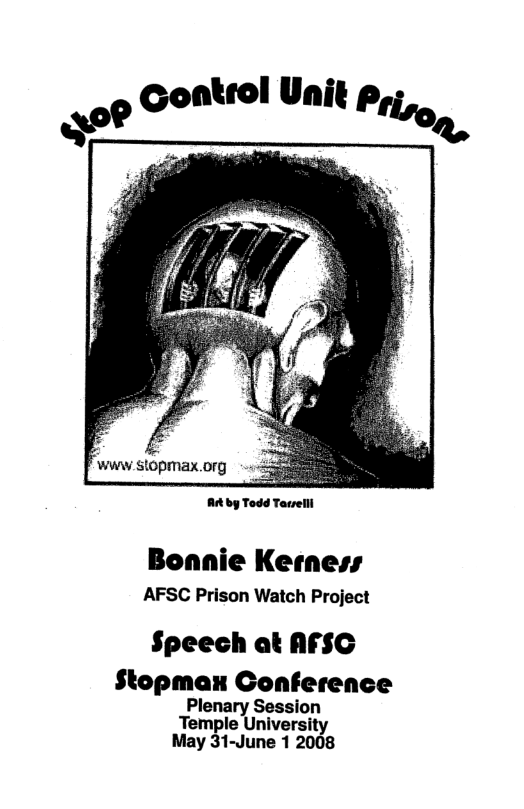
et by Todd Tawrelll
Bonnie Kerneyss
AFSC Prison Watch Project
Speech at AFSC
Stopmax Conference
Plenary Session
Temple University
May 31-June 1 2008
About the Artit
Todd (Hyung-Rae) Tarsell's nk drawings ilustrate the
exploitation of prisoners by the prison industrial com-
plex. He Is incarcerated at SCI Greene, a Pennsylvania
‘supermax prison. To contact Todd, or make a make a
donation toward art supplies write to:
‘Todd (Hyung-Rae) Tarselll
BY8025
175 Progress Drive
Waynesburg, PA 15370-8090
Boanie Kerness, AFSC Prison
Wateh Project
AFSC Stopmax Conference
Plenary Session
Temple University
May 31-June 12008
| want to thank the AFSC for renewing its commitment
to issues of isolation and torture In US prisons; the.
AFSC Healing Justice staff for their collective briliance
and spiit and Naima Black and the Stopmax Team for
‘organizing this extraordinary community.
In the mid 80's | received a letter from Ojore Lutalo who
had just been placed in the Management Control Unit
at Trenton State Prison. He asked what a control it
was, why he was in there and how long he would have
1o stay. At that point, we knew lte of control units, ex-
‘cept for the ground breaking work of Nancy Kurshan
‘and Steve Whitman of the Committee to End the
Marion Lockdown (CEML) and the many prisoners who
reached out to the AFSC, which, In 1885 produced a
‘pamphlet called “The Lessons of Marion". We began
hearing from peaple throughout the country saying that
they were prisoners being held In extended isolation for
politcal reasons. We also heard from jailhouse lawyers,
slamic militants and prisoner activists - many of whom
found themsalves locked down in 24/7 solitary confine-
ment. The AFSC began contacting people Inside and
outside the prisons o see who was interested in work-
ing specifically on control unitisolation Issues, and in
1994 (atter eight years of organizing) we hosted the
formation of the National Gampaign to Stop Control
Unit Prisons. This was done with the help of GEML,
‘Komboa Ervin, who was one of the Marion Brothers,
‘Corey Weinstein of Califoria Prison Focus, Alejandro
Molina from the Puerlo Rican Cultural Center, students
from Oberiin College, young peaple across the country
who belonged 1o the Anarchist Black Cross, the United
‘Church of Christ, Yaki Owusu of Spear and Shield, the
input of the women held in small group isolation at Lex-
ington, Ky. and many others who gave strength and
purpose to the work. Some of these people were ac-
tively involved in the different poliical movements of
the 60's and 70's and understood how control units
were being used against us al. Getting issues of isola-
tion and torture into the light has been a long road and |
bow in gratitude 1o those inside who so gracefull and
patiently mentored those of us on the outside.
In 1996, the National Campaign held four Regional
Hearings across the country, giving voice 1o people in
prison, ex-prisoners, family members, advocales, law-
yers and others whom were impacted by the use of
solation. In 1997 we came out with the Interim Report
‘which held data on the emergence of over 45 control
units or supermax prisons in almost every state. We
matched inside and outside monitors in each state and
formed the testimonies we received into a Listening
Project called “Testimonles of Torture" and the
“Survivor's Manuar”. In 1998, the National AFSC folded
the work of the Campaign into Newark, NJ's Prison
Watch Project of the New York Metropolitan Regional
Office. During the four years of it existence, NCSCUP
trained dozens of students in organizing principles, in-
cluding helping to develop about half a dozen campus
Prisoner Awareness groups. Many of those former stu-
dents are stil working for social change today.
‘The history of the Nafional Campaign to Stop Control
Unit Prisons really began with the movements of the
60's and 70's. My generation belonged to a society
‘where we genuinely belleved that each of us was free
to dissent polically. In those years, people acted out
this belef in a number of ways. Native peoples contrib-
uted to the formation of the American Indian Movement
dedicated to self determination; Puerto Ricans joined
the movement to free the istand from US colonialism;
white students formed the Students for a Democratic
Soclety and other groups, while others worked in the
southern Civil Rights movements. This was also a time
that the New Afrkan Independerice Movement reas-
serted itsel,the Black Panther Party for Self Defense
was formed, as well s a time where there was a dis-
tinct rise n the prisoner's rights movement. It was time
when television news had graphic pictures of State
Troopers, Police, the FBI, and the National Guard kil-
ing our peers. Itwas a time when | saw on the evening
news the bullet holes fired by police Into Panther Fred
Hampton's sleeping body, a time when young people.
protesting the Viet Nam War died on the Jackson and
Kent State campuses kiled by the National Guard, a
time when civil ights workers were killed with impunity,
‘and a time when we felt as If there was no opportunity
0 stop mouming because each day another activist
was dead. These killngs and other acts of oppression
led to underground formations such as the Black Lib-
eration Army and the Weathermen Underground.
‘The government, in response to this massive outory
against social Inequies and for national iberation, utl-
zed an FBI Counter Intelligence Program called GOIN-
‘TELPRO, which had as its objsctive the crippling of the
Black Panther Party and other radical forces. Over the
years that this directive was carried out, many of those
Young peaple who weren't murdered were put in pris-
ons across the country. Some, now in their 60's and
70's are still there. Those directives are sl being car-
ied out, only now we have an eniir office of Home-
land Securty monitoring what it calls radical prison-
s’
While the US denied that there were peaple being held
for poltical reasons, there was o way al the time, 1o
work with prisoners without hearing repeatediy of the
existence of such people, including individuals who
clearly it the United Nations defintion of political pris-
oners and prisoners of war - and the particular real-
ment they endured oncs in prison. As early as 1978,
Andrew Young , who was US Ambassado 1o the
United Nations, was quoted in newspaper interviews as
saying thal “there were hundreds, perhaps thousands
of people | would describe as political prisoners” in US.
prisons.
Across the nation, we saw an enhanced use of sensory
deprivation/isolation units for such people, and it was
this growing “special treatment” which we began moni-
toring. At the time, Ralph Arons, a former warden at
Marion, was quoled at a congressional hearing as say-
ing, “The purpose of the Marion Control Unit s 10 con-
trol revolutionary atitudes i the prison system and in
sociely at large’
For those of us who have been in the struggle for dec-
ades, the deliberate use of long ferm sensory depriva-
tion is haunting. People that we've known, worked with
‘and loved have been, and some stil are, being heid in
this manner. Some of those are peaple in the audience
today. The names - Ojore Lutalo; Sundiata Acol, who
the Management Control Unit in NJ was buil for in
1975; Assata Shakur, who was held for over five years
in isolation. Marshall Eddie Gonway, Albert Nuh Wash-
ington, who died in prison; Geronimo Pratt; Dhoruba
Bin Wahad, Dr. Mutulu Shakur, Mumia Abu Jamal; Leo-
nard Peltier, David Gilbert, Marllyn Buck, Sekou Od-
inga, Ray Luc Levasseur, Kazi Toure, Masai Ehehosi;
Leonard Peller, Oscar Lopez Rivera, Alejandrina Tor-
res, Dylcia Pagan, Bashir Hameed, Standing Doer and
Sekou Odinga, Lorenzo Kom'boa Ervin; Richard Wil
iams, Tom Manning, Merle and the rest of the Afrcas,
Africa, Susan Rosenberg, Laura Whilehom, Linda Ev-
‘ans, Marllyn Buck, Sylvia Baraldini, Mutuiu Shakur,
Imarm Jamil A-Amin - these names and dozens of oth-
ers - haunt the spaces of every control unit, SHU, DDU,
‘ad seg unit and special housing unit in the country. No
‘matter what name they are given, their purpose is the
same as itis in Abu Ghralb or Guantanamo - the break-
ing of minds. For every name I've read, there are a
thousand more.
For people of my generation, this work is done with a
compeling and lfetime passion and an understanding
that the work is not risk free. We've made promise to
those dead and alive to abolish these torture cham-
bers. People throughout the world are beginning to un-
derstand what the prisoners have been saying to us for
decades about the oppressive tactics of the US govern-
ment. The department of corrections is more than a set
of Institutions, it i a state of mind. It i that stale of
mind which has expanded the use of isolation, the use
of devices of torture and the Counter Inteligence Pro-
gram, as part of Homeland Security, against activists,
both inside and outside the walls. Ojore Lutalo, the
‘man who first contacted us in 1986, was released from
the control unit via liigation in 2002 after 16 years in
isolation. In 2004, he let us know that he had been
‘placed back into the Management Control unit with no
charges pending or any explanation. When | called the
Department of Corrections, it took many conversations
before | was biuntly told that this was upon the order of
Homeland Securty, that he Is one of a number of pris-
oners across the country who they have targeted in this
way.
‘The latest progression of control units are cafled
“security threat group management units". This is par-
ticularly egreglous because itis the government which
gets to define what a “securlty threat group® is. Accord-
ing to a national survey done by the Department of Jus-
tice in 1997, the Departments of Corrections of Minne-
‘sota and Oregon named all Asians as gangs, which
Minnesota further compounds by adding all Native
Americans. The State of NJ DOG lists the Black Cat
Collective as a gang. The Black Cat Collective is my
free fostor son along with two friends who put on Afro-
‘Centric cultural programs in libraries. Because my own
background stems from the Givil Rights Era, | am very
mindful of who Is considered a “securlty threat" to this
country and how they are treated.
Prison gang policles occur within the context oflarger
soclety and the wider criminal justce system, and the
9rowth of securlty threat group management units are
partof the larger pollcy agenda regarding S prisons.
One of the standards that the federal government sets
in order for states to receive prison construction subsi-
dies is to mandate the bulling of supermax prisons or
‘security threat group management units.
One of the things that makes this such an exciling time
1o re-new our efforts through Stopmax,is that we now
have the growing understanding of the validity United
Nations International law. The Convention Against Tor-
ture, the Convention on the Elimination of All Forms of
Racial Discrimination, The UN Convention on Poliical
‘and Civi Rights and other international and regional
realies help give us a new set of legal, educational and
organizing tools for social change.
Our work this weekend is very rooted in struggle
‘against the system and political oppression. It is deeply
touching to me to have representatives of so many long
time poliical formations present. Those of us In AFSC
rooted in these issues, continue to hear from prisoner
activists, the mentally il, people charged with being
‘gang members and thousands of others - all being
‘housed in extended isolation where devices of torture
are used with impunity. After each Homeland Security
Code change, Prison Watch is flooded with calls from
Ppeople reporting loved ones with Islamic names being
placed in solary without charges.
Our work this weekend is a time when the building of
new relationships and the broadening of our base can
truly create social change. | think we all need to be
‘mindful of the deep sense of grief that many of us feel
s L impacts on our work and interactions. There may
be groups here who need to work through differences.
with one another. There may be groups here who can
form working alliances no matter what those iffer-
‘ences are. Our priority has 1o be to work cooperalively
10 shut down these torture chambers.
| want to honor our foremothers and forefathers in this
‘movement for abolition of prisons, isolation and torture.
With a poem of Assata Shakur's called "No One Can
Stop the Rain", which reminds us that no one can stop
arighteous movement. We, allof us, are a powerful
‘community of resistance, and this s a dream come true
for me.
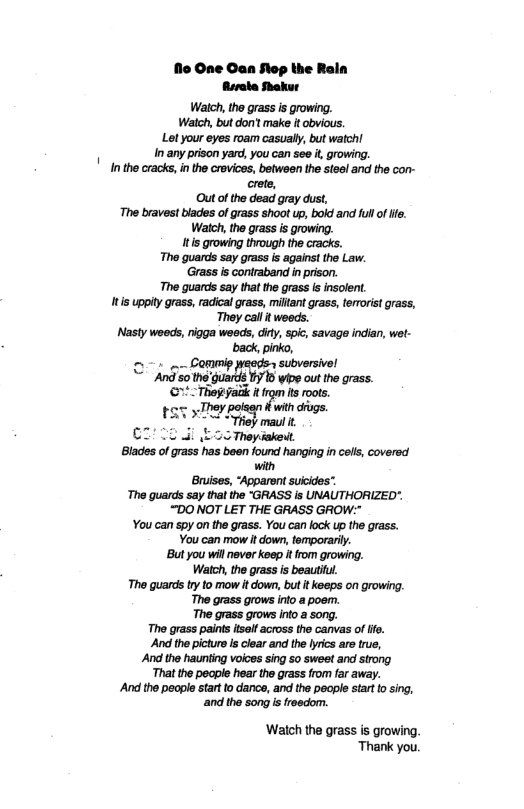
flo One Oan flop the Raln
Rsrate Shakur
Wach, the grass s growing.
Wt kot hoovess.
Let your eyes roam casually, but watch!
) n any prison yad, you can seo i, growing.
In the cracks, in the crevices, between the steel and the con-
crete,
Outaltho seigmy
e e indn o g s kst ot
ek b oo gomes
It growing through the cracks.
o s g s st Lo
(rrsimrbde i
e g oy et e € et
Itis uppity grass, radical grass, militant grass, terrorist grass,
They call it weeds.
Nasty woeds, nigga weeds, iy, spic, savage indian, wet-
back, pinko,
s
S verine g
dyrfoy
; ki
R ot
L2000 4L Lo Theyiakent.
locn e i o s g ot coran
with.
Bruises, *Apparent suicides”.
T s oy e S STHOR D"
DN LB e GoASS OO
You can spy on the grass. You can lock up the grass.
You can mow it down, temporarily.
Watch, the grass is beautiful.
o s 0 mom o o oups ot roWEG
The grass grows into a poem.
T pess e g
The grass paints itself across the canvas of life.
And the picture Is clear and the lyrics are true,
And the haunting voioes sing so sweet and strong.
That the peaple hear the grass from far away.
‘And the peaple start to dance, and the people start o sing,
i o oo
Walch the grass is growing.
Thank you.
South Chicago ABC
P.O. Box 721
Homewood, IL 60430
For More Info Contact:
Prison Watch
c/o AFSC
89 Market St
6th Floor
Newark, NJ 07102
973-643-3192
wwww,afsc.org/PrisonWatch
Dhemess@afsc.oq